
Keywords: Family Business • Values • Identity • Succession • Legacy • Familiness
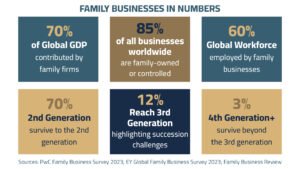
FAMILY BUSINESSES IN NUMBERS
1-Introduction
The identity of family businesses is woven from a uniquely human fabric, carrying within it stories of deep-rooted relationships, inherited values, and a shared history that transcends generations. Unlike other organizational forms, family enterprises are not guided by financial indicators alone; they are equally shaped by emotional bonds, moral commitments, and a collective sense of belonging. This distinctive combination grants family businesses a remarkable capacity for resilience and longevity, enabling them to outperform and outlast their non-family counterparts over the long term.
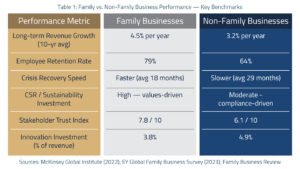
According to the PwC Family Business Survey (2023), 87% of family business leaders believe their firm’s values provide a meaningful competitive advantage. Furthermore, research published in the Family Business Review demonstrates that family firms with clearly articulated values consistently outperform their peers in employee retention, customer loyalty, and long-term profitability.
This article explores how values and identity constitute the cornerstone of family businesses across generations, and how they shape continuity, resilience, and long-term competitiveness. It examines how the integration of family values with business identity creates a distinctive organizational culture—commonly described as familiness—that influences decision-making, governance structures, and relationships with stakeholders.
2. What is Family Business Identity?
Family business identity is the unique moral fabric that emerges from the integration of the spheres of family and business into a single, coherent entity. It is not merely the family name on the signboard, but a living system that embodies three fundamental pillars: the tangible involvement of the family in ownership and management; the value-based essence manifested in shared ethics and vision; and the identity prominence expressed through the family’s reputation and community engagement. These elements interact to form an inimitable imprint that distinguishes the firm and guides its decisions across generations. It serves as a strategic compass that bridges the legacy of the past with the necessities of the present.
3. Social and Organizational Identity in Family Businesses
In family enterprises, family identity and organizational identity are deeply intertwined, jointly shaping the firm’s image, reputation, and internal dynamics. Reputation in this context is strongly grounded in trust, as non-family stakeholders often observe positive emotional ties, mutual support, altruistic behavior, and a strong sense of responsibility among family members. These visible attributes enhance credibility and foster long-term relationships with employees, partners, and communities.
A family business therefore embodies two interrelated identities: the family’s individual identity, rooted in core values and beliefs, and the organization’s identity as an economic and social actor. The extent to which these identities are integrated—or deliberately separated—significantly influences decision-making processes, role clarity, and governance effectiveness.
3.1.The Role of Social Identity and Familiness
Social identity plays a critical role in fostering trust and collaboration within the family firms. Members who belong to the same group or share similar backgrounds and experiences tend to understand one another better, trust each other more, and prioritize group goals over individual interests, strengthening teamwork and collective achievement.
In family businesses, social identity is particularly complex due to the emotional bonds between members, interdependence across multiple dimensions, and shared intergenerational history. Ownership, managerial roles, and family status are closely linked to individual identity, reinforcing influence within the firm and strengthening the connection between the family and business operations.
Shared identity provides significant advantages through social capital, stewardship behavior, and a shared sense of purpose. The concept of “familiness” captures this unique overlap between family and business, reflected in internal networks, shared vision, mutual trust, and behavioral norms guiding interaction within the company.
A strong family identity supports collaboration, knowledge sharing, and long-term commitment among members. It also ensures that relationships within the business are resilient and sustainable over time—resources that are often absent in non-family firms.
The influence of family identity is evident in members’ behavior: many family business owners who sell their companies later attempt to reacquire them, motivated by the loss of identity following the sale. These strong family ties make the business system capable of continuity and adaptation to challenges, while preserving the family’s core values and principles across generations
A 2022 KPMG study of 2,439 family businesses across 82 countries found that firms with high familiness scores were 34% more likely to report above-average revenue growth and 41% more likely to have lower employee turnover compared to peers with weak family identity integration.
4.Values at the Heart of Family Businesses
At the core of family business identity lie family values. These values form both the ethical foundation and the strategic framework of the enterprise, defining what the family and the business ultimately stand for. Far from being abstract ideals, values operate as dynamic forces that shape behavior, influence priorities, and establish decision-making standards across generations.
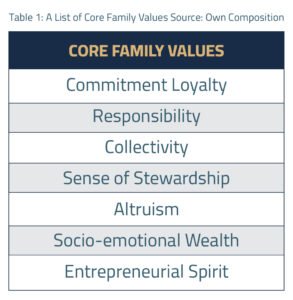
Core values such as commitment, loyalty, responsibility, and collective spirit are often deeply rooted in the founder’s vision. Over time, they evolve into an intimate organizational culture that fosters employee dedication, internal trust, and social cohesion. This distinctive bundle of values constitutes a rare and valuable strategic resource—what scholars describe as ‘familiness.’
5.From Values to Competitive Advantage: How Families Shape Survival Capability?
A family’s commitment to deeply held values such as loyalty, shared identity, and a sense of social responsibility creates a unique social fabric within a family business. Values are not merely slogans; they transform into tangible drivers that push the company toward adopting sustainable and responsible behaviors. When the family feels its destiny is intertwined with the company’s reputation and legacy, preserving that reputation becomes a powerful intrinsic motivator to invest in social and environmental initiatives—even those that may not yield immediate or direct financial returns
This influence stems from the fact that family identity and business identity merge, so that the success and stability of the community become part of the family’s own definition of success. This organic connection translates practically into treating employees as extended family, investing in the development of the local community, and cultivating a strong reputation that benefits future generations. The social and emotional wealth the family gains from this positive reputation and strong relationships becomes an invaluable asset, sometimes even more valuable than fleeting financial gains
Therefore, embracing values does not only lend a human character to the family business but also transforms it into a more resilient and sustainable entity. The company does not engage with society merely as an external market, but as a partner in destiny, deepening its roots and ensuring the long-term loyalty of customers and employees. In this context, family values evolve from mere ethical principles into an existential strategy that supports the survival and flourishing of the business across generations, creating a resilience and competitive advantage that is difficult for conventional companies to replicate
6.How Core Values Forge an Enduring Identity Across Generations?
Maintaining identity and values across generations in family businesses represents a dynamic journey of balance between authenticity and renewal. This journey begins with the founding generation embedding their personal values into the fabric of the nascent company, transforming them into a living legacy. Each successive generation faces the challenge of reinterpreting this inheritance rather than merely preserving it.
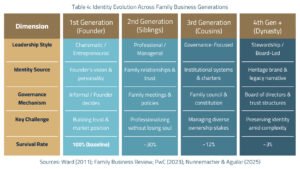
7.Key Strategies for Effective Identity Management:
7.1 Develop a Clear Identity Strategy
A strong identity begins with a clear vision, a well-defined mission, and a values framework that authentically reflects the family’s principles and long-term aspirations. Research by EY (2023) shows that family businesses with a documented values framework are 2.3x more likely to successfully complete leadership transitions.
7.2 Establish a Corporate Identity Manual
As family businesses expand and establish subsidiaries, consistency becomes essential. A comprehensive corporate identity manual helps maintain a unified visual and verbal identity across all entities, covering branding elements, messaging, and tone of voice to ensure coherence and recognition.
7.3 Design a Strong Identity Architecture
A robust identity architecture clarifies the relationship between the parent company and its subsidiaries, reinforcing the overall family brand while permitting operational flexibility across business units.
7.4 Engage Stakeholders Continuously
Across all organizations, effective engagement with stakeholders—including employees, customers, and communities—is essential, particularly during periods of growth and change. According to Edelman’s Trust Barometer (2023), family-owned businesses score consistently 12–18% higher on trust metrics than publicly traded companies.
7.5 Build a Strong Digital Presence
A strong digital presence is critically important in the modern era. Family businesses need to maximize the use of digital marketing strategies to enhance identity visibility and engage a broad audience, including active social media engagement, content marketing, and user-friendly digital platforms that communicate heritage and values authentically.
8. Conclusion
The identity of a family business transcends historical legacy to emerge as a living, dynamic, and perpetually renewed project. Core family values—such as loyalty, responsibility, and collective spirit—serve not as decorative slogans, but as vital forces that fuel sustainable growth, transforming emotional heritage into a lasting and inimitable competitive advantage.
The enduring survival of family businesses across generations is neither accidental nor guaranteed; it is a deliberate strategic accomplishment. It rests upon a delicate and ongoing equilibrium between three interdependent pillars: meaningful family involvement, an authentic value-based essence, and a distinct, respected identity within the wider community.
In an era characterized by rapid economic, technological, and social disruption, family businesses stand as compelling examples of resilience rooted in authentic identity. A strong, values-driven identity functions simultaneously as a protective shield against volatility and a strategic compass for navigating uncertainty—empowering family businesses to honor their legacy while confidently shaping a sustainable future.
Reference :
- Andreasson, A., & Svensson, M. (2024). The influence of generational perspectives on the link between family values and corporate sustainability in family firms [Master’s thesis, Jönköping University]..pdf
- Family business identity: Unveiling the Unique Identity of Family Businesses in the Startup Ecosystem Website
- EY. (2023). Global Family Business Survey 2023: Bridging generations. Ernst & Young Global Limited.
- KPMG. (2022). Family business report 2022: Championing resilience in uncertain times.
- McKinsey Global Institute. (2022). The resilience of family businesses: Delivering superior returns.
Nunnemacher, H., & Aguilar, E. (2025). Family business: Generational identity and succession planning. Research in Business and Economics Journal, 13. Galland Henning Nopak, Inc.; iQuality, LLC. Retrieved from https://www.aabri.com/manuscripts/182832.pdf
No comment